
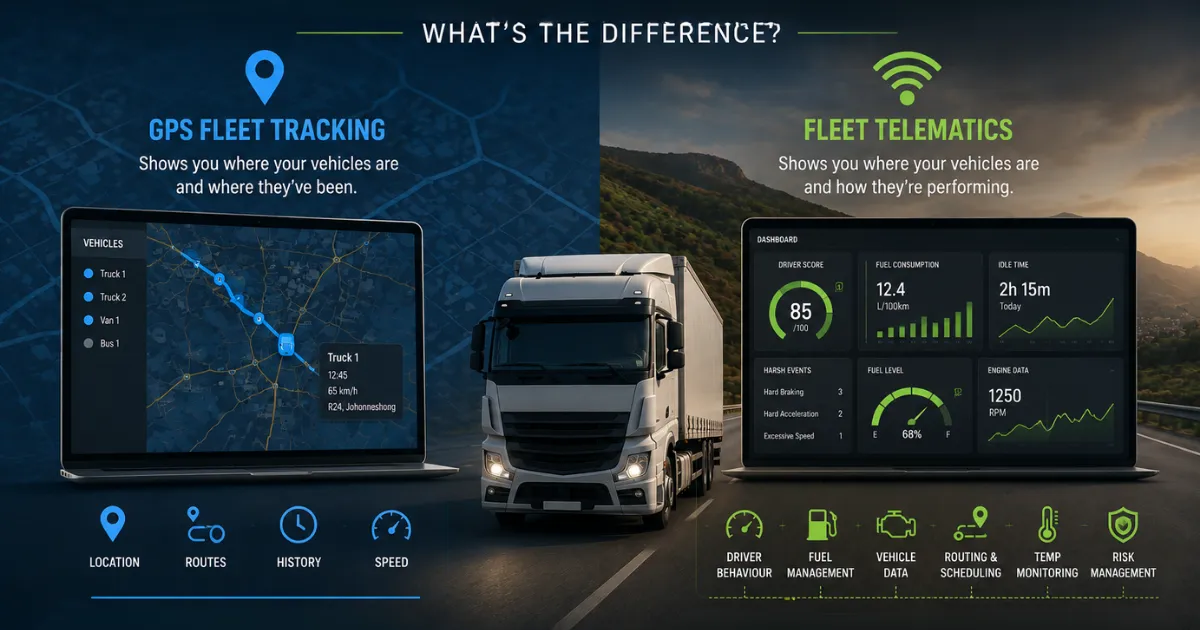
If you manage a fleet of vehicles, knowing where they are is important. But location is only one part of the picture.
For years, GPS vehicle tracking has been one of the most familiar tools used by fleet operators. It provides visibility over vehicle locations, routes and movements, helping businesses keep track of valuable assets.
Modern fleet operations, however, demand much more information.
Fleet managers want to know how vehicles are being driven, how much fuel they are consuming, whether drivers are following planned routes, where operational risks are developing and how efficiently the fleet is performing.
This is where fleet telematics comes in.
Although GPS fleet tracking and telematics are often spoken about as if they are the same thing, there are important differences between them.
What Is GPS Fleet Tracking?
At its simplest, GPS fleet tracking uses Global Positioning System technology to determine the location of a vehicle.
A GPS tracking device installed in the vehicle communicates location information to a central platform. Fleet managers can then see where vehicles are and, depending on the system, review their previous movements.
GPS vehicle tracking can provide information such as:
- Current vehicle location
- Previous journeys
- Routes travelled
- Arrival and departure times
- Vehicle speed
- Stops and periods of inactivity
- Geofencing information
For businesses that simply need better visibility over where their vehicles are operating, GPS tracking can be extremely useful.
The limitation is that location does not always explain what is happening with the vehicle.
A truck might be exactly where it should be, for example, but could be idling unnecessarily. A bus may be travelling along the correct route, but the driver could be braking harshly or operating inefficiently.
To understand those situations, you need more than a location pin on a map.
What Is Fleet Telematics?
Fleet telematics combines GPS tracking with vehicle, driver and operational data to provide a much more detailed picture of fleet performance.
Rather than simply answering the question, “Where is my vehicle?”, telematics can help answer questions such as:
- How is the vehicle being driven?
- How much fuel is it consuming?
- Is the engine being operated efficiently?
- Is the driver following the correct route?
- Is excessive idling occurring?
- Are there high-risk driving events?
- Is a refrigerated load maintaining the correct temperature?
- Are there operational exceptions that require attention?
This information gives fleet operators a clearer understanding of what is happening across their business.
Edge Telematics provides customised fleet management solutions that combine vehicle tracking with technologies including fuel management, driver monitoring, CANbus integration, routing and scheduling, cold chain monitoring and operational control.
GPS Tracking vs Fleet Telematics
The easiest way to understand the difference is to think about visibility versus intelligence.
GPS tracking primarily tells you where a vehicle is and where it has been.
Fleet telematics uses that location information alongside other data to help explain how the vehicle, driver and operation are performing.
For example, GPS tracking may show that a truck travelled from Johannesburg to Durban.
A telematics system could provide additional information about that same journey, including fuel consumption, driver behaviour, excessive idling, speeding events, route deviations and vehicle data.
That additional context can help fleet managers make better operational decisions.
1. Driver Behaviour Monitoring
One of the biggest advantages of fleet telematics is the ability to understand how vehicles are being driven.
Driving behaviour can have a direct impact on safety, fuel consumption and vehicle wear.
Telematics can help operators identify events such as harsh acceleration, harsh braking, speeding, excessive idling and inefficient engine use.
Edge Telematics can combine this information with solutions such as Advanced Eco-Drive, helping operators analyse driver performance and encourage more efficient driving.
For fleet managers, this turns driver performance into something measurable.
Instead of relying purely on assumptions or feedback after an incident, managers have data they can use for coaching, training and performance management.
2. Fuel Management
Knowing where your vehicles are does not tell you where your fuel is going.
Fuel is one of the largest operating costs for many South African fleets, making fleet fuel management an important part of modern telematics.
Edge Telematics offers fuel management capabilities that can incorporate technologies such as fuel probes, smart filler caps, fleet card integration and CANbus data.
This gives operators greater insight into fuel consumption and unusual fuel activity.
Fleet managers can identify excessive idling, inefficient driving and potential fuel losses rather than simply accepting a high monthly fuel bill.
3. CANbus Integration
Another important difference between basic GPS tracking and more advanced telematics is access to vehicle data.
Through CANbus integration, telematics can access information generated by the vehicle itself.
This can provide deeper insight into engine and vehicle performance, including information related to fuel consumption, RPM and operating behaviour.
For businesses trying to reduce fleet operating costs, this data provides valuable context.
A vehicle may be completing the correct route, but CANbus information could reveal inefficient engine use that is contributing to higher fuel consumption.
4. Routing and Scheduling
GPS can show where a vehicle travelled. More advanced fleet technology can help determine where it should travel.
Routing and scheduling solutions can help operators plan more efficient journeys, reduce unnecessary mileage and improve operational performance.
For passenger transport operators, Edge Telematics offers EdgeBus Routing & Scheduling, a solution built specifically around bus operations.
Better routing is not simply about finding the shortest road between two points. Bus operators, for example, need to consider routes, schedules, service delivery and operational compliance.
By combining routing information with real-time vehicle data, operators gain greater control over what is happening across their network.
5. Driver and Road Risk Monitoring
Traditional GPS tracking has limited ability to explain what happened inside or around a vehicle during a high-risk event.
Modern fleet telematics can add technologies such as dashcams, Advanced Driver Assistance Systems (ADAS) and Driver State Monitoring (DSM).
These tools can provide greater visibility into road conditions and driver behaviour.
For example, DSM can help identify potentially risky behaviours such as fatigue or distraction, while ADAS can support the identification of developing road risks.
When combined with vehicle and location data, video provides fleet managers with a more complete picture of an incident.
6. Cold Chain Monitoring
The difference between tracking and telematics becomes particularly clear in refrigerated transport.
A GPS system may tell a fleet manager exactly where a refrigerated truck is.
That does not necessarily tell them whether the load is being kept at the required temperature.
Edge Telematics’ Thermo King integration allows refrigerated fleet operators to bring cold-chain information into their telematics environment.
This creates visibility beyond the vehicle’s physical location and allows operators to monitor information that is directly relevant to protecting temperature-sensitive cargo.
For cold-chain businesses, knowing where the truck is matters. Knowing what is happening to the load matters just as much.
7. Real-Time Operational Control
The real value of fleet telematics is often not the amount of data collected, but how quickly a business can act on it.
Instead of reviewing information only after something has gone wrong, telematics can help identify operational exceptions and high-risk events as they happen.
Edge Telematics’ Operations Control Centre and Vision solutions provide an additional layer of monitoring and operational visibility.
This helps businesses focus attention on the incidents and exceptions that require action rather than manually watching every vehicle throughout the day.
Do You Need GPS Tracking or Fleet Telematics?
The answer depends on what you want to achieve.
If your primary requirement is simply knowing where vehicles are located, GPS tracking may provide the basic visibility you need.
If you want to improve fuel efficiency, driver behaviour, fleet safety, route performance, operational control and overall fleet productivity, a broader telematics solution can provide far greater value.
The question is therefore not simply whether your business needs vehicle tracking.
It is what you want to do with the information once you have it.
Move Beyond the Dot on the Map
GPS tracking remains an important part of modern fleet management, but it is only the starting point.
For South African businesses operating buses, trucks, vans and specialised fleets, the bigger opportunity lies in connecting vehicle location with meaningful operational data.
Edge Telematics works closely with fleet operators to understand their specific requirements and build customised solutions around them. From GPS vehicle tracking and fuel management to driver monitoring, routing and scheduling, cold chain management and operational control, the focus is on providing the information businesses need to operate more efficiently.
When you can see not only where your fleet is, but also how it is performing, you can make better decisions about costs, risk and productivity.
Analyse. Customise. Optimise.
Discover how Edge Telematics can help you move beyond basic GPS fleet tracking and gain greater visibility across your operation.
Connect with us on LinkedIn: https://www.linkedin.com/company/edge-telematics/
Learn more about our solutions: https://edgetelematics.com/